The change plan can be flawless and the project will still fail if leaders misread what their people are actually defending. A guide to the Change Curve, and to the perceived losses that drive resistance at every stage.
Most change initiatives arrive with an impressive technical plan. Systems mapped, milestones set, communications scheduled. And a striking number of them fail anyway, because the plan accounts for everything except the part of the organisation that has feelings about it.
At Vitr we ground our change work in adaptive leadership, the framework developed by Ronald Heifetz and his colleagues at Harvard for challenges that have no purely technical solution. Its most useful insight is also its simplest. People do not resist change; they resist loss. Nobody fights the new system because it is new. They fight it because of what they believe it will take from them.
Diagnosing the loss
Those losses are rarely stated out loud, and they are rarely the ones on the risk register. Job security is the obvious one, but in our experience it is seldom the most powerful. The deeper losses are status, when the restructure flattens someone's hard-won position. Identity, when the expert whose mastery of the old system defined their worth becomes a beginner overnight. Competence, when capable people privately fear they cannot learn the new way. Power, when the change redraws who decides what.
This gives leaders a diagnostic question worth asking before any change plan is finalised: for each stakeholder group, what do they stand to lose, and do they know it yet? The people who resist hardest are almost always the people with the most to lose, and their resistance is rational from where they sit. Treating it as obstruction misses the point. Treating it as information is where change leadership starts.
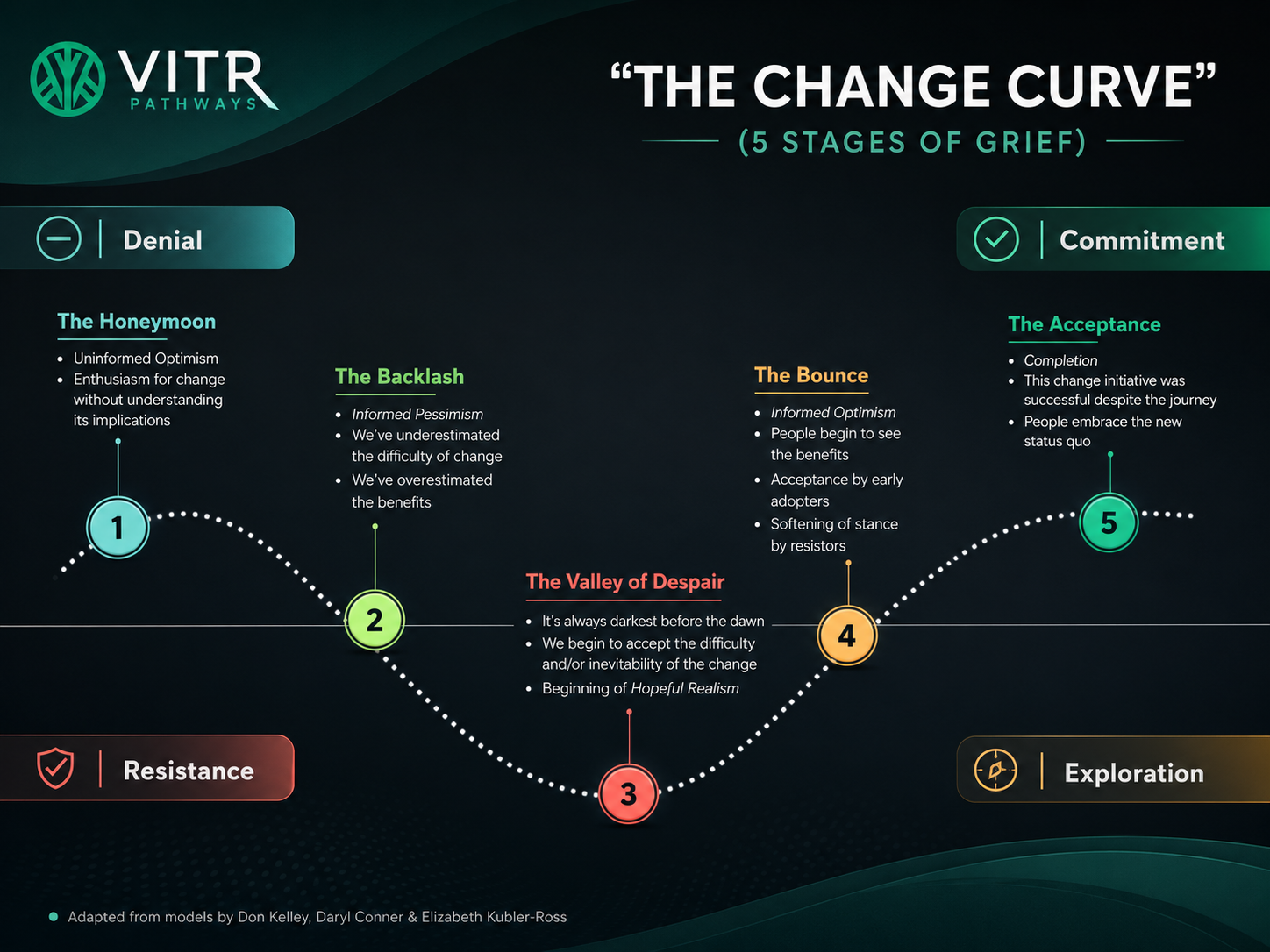
The Change Curve
To map how those losses are felt over time, we use the Change Curve, adapted from Kubler-Ross's stages of grief and layered with the work of Don Kelley and Daryl Conner. The grief lineage is apt, because moving through change is substantially a process of mourning the old state.
The Honeymoon (uninformed optimism). Enthusiasm is high because information is low. Nobody has yet worked out what the change will cost them personally. Leaders often mistake this stage for buy-in and declare victory early, which makes the next stage hit harder.
The Backlash (informed pessimism). Reality arrives. The difficulty was underestimated, the benefits were oversold, and people begin the private arithmetic of what they stand to lose. Resistance surfaces here, usually first as scepticism in meetings and slow-walking between them.
The Valley of Despair. Resistance peaks and morale bottoms out. The perceived losses feel total, and this is where change initiatives die, because leaders either lose their nerve and retreat, or push harder on the technical plan when the problem is emotional. The work here is naming the losses honestly, distinguishing what is genuinely being lost from what merely feels at risk, and holding the direction steady while people grieve the old state. There is a reason the darkest point of the curve sits directly before the turn.
The Bounce (informed optimism). Tangible benefits start to appear and early adopters begin pulling others through. The leader's job shifts from defending the change to amplifying evidence: making early wins visible, and giving former resistors a dignified path to change their position.
The Acceptance. The new state becomes the normal state. The losses that dominated the valley are now outweighed by gains people can see and feel, and the energy spent resisting returns to the work itself.
What this asks of leaders
The technical plan tells you what is changing. The curve tells you what your people are experiencing while it changes, and the loss diagnosis tells you why. Effective change leaders run all three at once. They anticipate the emotional journey before it begins, they treat resistance as data about unaddressed loss rather than as disloyalty, and they calibrate their leadership to the stage their people are actually in rather than the stage the project plan assumes.
Change succeeds when the humans do. If your organisation is heading into a significant change, or is somewhere on this curve already and finding the valley deeper than expected, talk to us about our change services. Diagnosing where the loss sits, and leading people through it, is exactly the work we do.